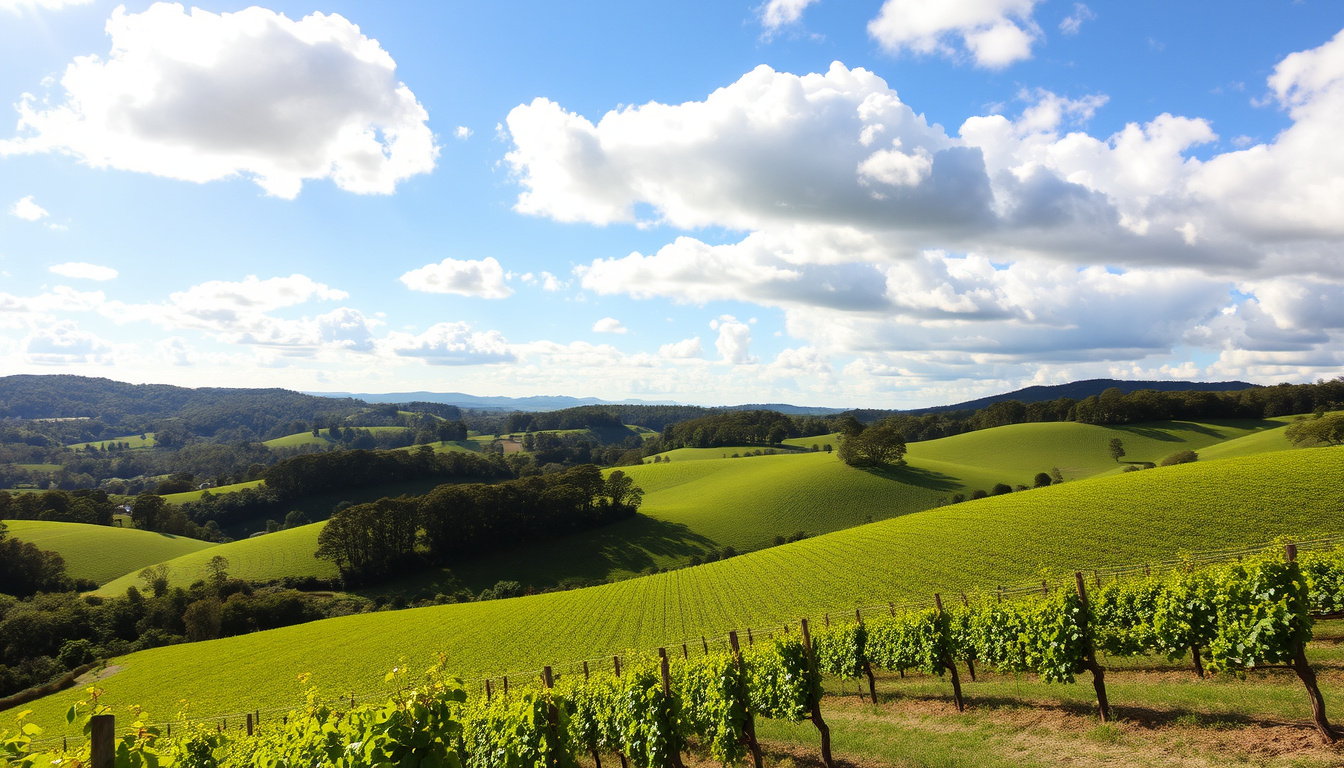

If you’ve ever packed for a weekend in wine country only to get soaked by an afternoon storm — or worse, wilted in 35 °C heat during a vineyard tour — you already know that timing matters in the Hunter. The valley’s weather swings harder than most Sydney day-trippers expect, swinging from crisp winter mornings to summer scorchers that test your sunscreen tolerance.
Daytime Highs: low to mid 20s °C · Overnight Lows: 7 to 11 °C · Current Conditions: partly cloudy, around 20 °C · UV Protection Needed: 9:40 am to 2:00 pm · Feels Like: 76 °F
Quick snapshot
- Pokolbin is the main town of Hunter Valley wine country (Weatherzone)
- BoM issues official forecasts for Pokolbin with 7–14 day outlooks (Bureau of Meteorology)
- Peak UV index reaches 10 (Very High) — sun protection required 9:30 am–4:40 pm (Bureau of Meteorology)
- Exact hottest-month average — January and February both post high-30s peaks (WillyWeather)
- Microclimate differences between upper and lower Hunter subregions lack granular public data (WillyWeather)
- Grape harvest runs early Jan to mid-Feb — wine events peak, cellar doors are active (Wine Party Tours)
- Frost risk drops after second week of September — spring kicks in (Hunter Valley Tours)
- Daytime temperatures hold in the low-to-mid 20s through the next week, with overnight lows of 7–11 °C (Bureau of Meteorology)
- Clear-to-partly-cloudy skies dominate — precipitation risk stays low for now (Bureau of Meteorology)
Seasonal temperature and rainfall patterns for Pokolbin in the Hunter Valley wine region are summarised in the table below.
| Label | Value |
|---|---|
| Main Town | Pokolbin |
| Forecast Source | Bureau of Meteorology (BoM) |
| Daytime Temps (current pattern) | Low-to-mid 20s °C |
| Overnight Temps (current pattern) | 7–11 °C |
| Precipitation Risk | Low at present |
| Spring Temp Range | 10.3–24 °C |
| Summer Temp Range | 17.5–26.3 °C |
| Autumn Max Temp | 25.2 °C average |
| Winter Temp Range | 7.1–18.3 °C |
| Spring Rainfall | 61–81 mm |
| Harvest Period | Early Jan to mid-Feb |
| Record Low (2026) | 3.4 °C on 19 Apr |
| Record High (2026) | 40.7 °C on 9 Jan |
“Spring also takes the cake with the lowest rainfall season on average.” — Tulloch Wines, winery blog
What is the best time to visit Hunter Valley?
Spring (September–November) and autumn (March–May) divide the consensus among tour operators and winery blogs. The majority call spring the single best window, citing the lowest seasonal rainfall and daytime temperatures that rarely push past 24 °C (Tulloch Wines, Grape Experience Tours). Tourism Australia’s own guide lists spring as the recommended season for mild weather and minimal rainfall (Tourism Australia).
“After years of visiting this beautiful countryside, this is the best time to visit Hunter Valley in our opinion.” — Hunter Valley Tours, tour operator
Spring and Autumn for mild weather
Spring brings daytime highs of 10.3–24 °C and the year’s lowest rainfall (61–81 mm across September–November) (Hunter Valley Tours). Autumn settles around a maximum of 25.2 °C with cooler nights near 10.9 °C — pleasant for wine-tasting walks, but expect 101–115 mm of rain across March–May (Hunter Valley Tours). Both seasons offer quieter cellar doors than the summer school-holiday rush.
Summer highs and risks
Summer temperatures run 17.5–26.3 °C on average, but they regularly exceed 30 °C on hot days — and the 2026 record shows the valley can hit 40.7 °C (WillyWeather). January and February together carry the year’s highest fire risk in the Greater Hunter region (Bureau of Meteorology). Summer is peak tourist season for a reason (events, long daylight hours), but heat management becomes a practical planning concern.
Winter lows
Winter (June–August) sees overnight lows of 7.1 °C against daytime highs of 18.3 °C — cool enough for frost on the vines but often paired with clear, blue skies and average afternoon temperatures around 18 °C (HV Tours). Rainfall sits at roughly 120 mm early winter and 69 mm mid-winter, so wet-day planning is still relevant (Hunter Valley Tours).
What is the hottest month in Hunter Valley?
January typically posts the highest maximums, though February runs a close second and can be equally intense. The 2026 record high of 40.7 °C landed on 9 January (WillyWeather), and multi-source seasonal averages show summer (December–February) as a whole running 17.5–26.3 °C on typical days with spikes well above 30 °C (Hunter Valley Tours).
Summer peak temperatures
Daytime maxima in January and February regularly climb past the long-term average of 26.3 °C. Hot days above 35 °C are not uncommon during sustained heatwaves. The BoM forecast for the coming days shows daytime temperatures reaching 29–35 °C after foggy starts, with southeasterly winds of 15–20 km/h that offer some relief (Bureau of Meteorology). Fire danger in the Greater Hunter sits at Moderate for the current period, though this typically escalates to High and above during active summer heatwaves (Bureau of Meteorology).
Climate averages
Long-term climate averages for Pokolbin show January and February as the warmest two-month window in the calendar year, with February also carrying heavier rainfall (74–113 mm for summer, heavier in February) (Hunter Valley Tours). If your schedule is flexible, the weeks either side of the January peak — late November through mid-December — tend to be warm without yet hitting the year’s thermal peak.
What is the coldest month in Hunter Valley?
July is typically the coldest month, with overnight lows that can dip to 5–10 °C depending on the exact subregion and elevation. The 2026 record low of 3.4 °C was logged on 19 April (WillyWeather) — an outlier compared to the usual July minimum, but one that shows cold snaps can arrive outside deep winter too.
Winter lows
The June–August temperature range averages 7.1–18.3 °C (Hunter Valley Tours). Frost is a genuine risk in low-lying vineyard blocks, particularly in June as the coldest month sets in. Tour operators note that frost risk drops sharply after the second week of September (Hunter Valley Tours), making early spring a safer bet for cold-sensitive visitors.
How cold it gets
Pokolbin’s recent data shows lows of 4.5 °C on 20 April (Weatherzone) and a record 3.4 °C on 19 April 2026 (WillyWeather). The practical takeaway: layer up for any early-morning activity (balloon flights, vineyard walks) regardless of season, and assume that autumn and spring mornings can feel markedly colder than the daytime highs suggest.
Spring and autumn dominate the “best time” conversation, but they are also the valley’s busiest booking windows for cellar-door experiences. Visitors prioritising wine tourism over weather perfection should reserve accommodation and winery tours 4–6 weeks ahead during September–November and March–May.
Hunter Valley Weather Forecast
The Bureau of Meteorology issues the most reliable short-term outlook for Pokolbin, covering the next 7–14 days with daily maximum and minimum temperatures, rainfall probability, wind speed, and UV index. Extended forecasts from Timeanddate and YR.no provide 14–30 day outlooks with lower precision but useful directional trends for trip planning (Bureau of Meteorology detailed forecast).
7-day forecast
BoM’s 7-day outlook for Pokolbin shows daytime temperatures in the 20s °C with overnight lows between 7–11 °C, partly cloudy skies, and generally low precipitation risk (Bureau of Meteorology). A typical day’s range might run from a foggy 14–17 °C morning minimum to a sunny 29–35 °C afternoon maximum, with southeasterly winds around 15–20 km/h (Bureau of Meteorology).
14-day extended
Extended forecasts from YR.no and Timeanddate show the low-to-mid-20s °C daytime pattern holding through the next two weeks, with nights settling around 7–11 °C and clear-to-partly-cloudy conditions prevailing. Rain probability remains low for the current period, though afternoon shower chances vary day to day (Bureau of Meteorology). Check BoM’s detailed forecast page for wind gusts and any fire-weather upgrades as the season shifts.
Tomorrow’s outlook
The immediate 24-hour outlook for Pokolbin calls for partly cloudy conditions, a 50% chance of light rain (0–5 mm), an overnight minimum near 18 °C, and a daytime maximum around 28 °C (Bureau of Meteorology). UV Index is expected to reach 10 (Very High), with sun protection recommended from 9:30 am to 4:40 pm (Bureau of Meteorology).
The Greater Hunter fire-danger rating sits at Moderate now, but BoM upgrades this to High or Severe during extended dry-and-hot spells. Visitors between December and March should bookmark the Bureau of Meteorology’s fire-weather page alongside their accommodation confirmation.
Pokolbin Hunter Valley Weather
Pokolbin sits at the geographic and cultural heart of the Hunter Valley wine region. Its weather governs much of the valley’s day-to-day conditions, though subregional differences between the Lower and Upper Hunter mean that thunderstorm activity can be more pronounced in the lower valleys on any given afternoon (Bureau of Meteorology).
Current conditions
At the time of writing, Pokolbin is reporting partly cloudy skies, 20 °C, and 60% humidity. Daytime temperatures over the next week are forecast in the low-to-mid 20s °C, with overnight lows between 7–11 °C (Bureau of Meteorology). These are comfortable conditions for outdoor wine tours and reflect the current transitional season pattern.
Main town climate
Pokolbin’s climate table tells a clear seasonal story. Summer (December–February) averages 17.5–26.3 °C with occasional spikes past 40 °C. Winter (June–August) drops to 7.1–18.3 °C. Spring and autumn split the difference comfortably at 10–25 °C. Rainfall follows an inverse pattern to temperature: spring is driest (61–81 mm), winter wettest (120 mm in early winter), with summer and autumn intermediate (Hunter Valley Tours).
Pokolbin is genuinely comfortable for outdoor wine tourism roughly 8 months of the year (September–April), with July–August requiring more cold-weather gear and December–February demanding serious sun protection and heat management. The valley rewards the prepared traveller.
Related reading: Jamberoo Water Park guide · Crown Hotel Sydney guide
Travelers using our BOM forecast and seasonal guide for Pokolbin often explore Hunter Valley accommodation alongside to book ideal vineyard retreats or family stays.
Frequently asked questions
How cold does Hunter Valley get in winter?
Winter overnight lows in Pokolbin average 7.1 °C (June–August), with the coldest months dipping to 5–10 °C in low-lying vineyard areas. Frost is possible on clear winter mornings. The 2026 record low of 3.4 °C was logged on 19 April, showing cold snaps can occur outside deep winter too (WillyWeather). Pack a warm layer for any early-morning activity year-round.
What is the average rainfall in Hunter Valley?
Spring (September–November) is the driest season at 61–81 mm. Autumn receives 101–115 mm, summer 74–113 mm (heavier in February), and early winter around 120 mm (Hunter Valley Tours). If keeping dry on your vineyard walk is a priority, target spring.
Is Hunter Valley weather suitable for wine tours year-round?
Yes — cellar doors operate every month. Summer and winter require more planning: heat management and sun protection in December–February, warm layers and shorter daylight hours in June–August. Spring and autumn offer the most forgiving conditions for full-day outdoor itineraries.
What to wear in Hunter Valley based on weather?
Layering is the default strategy. Summer: light breathable fabrics, hat, SPF 50+ sunscreen (UV reaches 10 on high-UV days) (Bureau of Meteorology). Spring/autumn: a light jacket or sweater for mornings and evenings, comfortable walking shoes. Winter: warm layers, scarf, and gloves for early-morning balloon or vineyard walks.
Does Hunter Valley have extreme weather events?
The valley can experience heatwaves above 40 °C (record 40.7 °C on 9 January 2026) (WillyWeather), summer thunderstorms, and occasional bushfire smoke from the Greater Hunter region. Fire danger is currently Moderate and upgrades to High during dry-hot spells. No extraordinary precautions are needed beyond standard Australian bushfire awareness during summer and early autumn.
What is the UV index like in Hunter Valley?
The UV Index regularly reaches 10 (Very High) during sunny months, with sun protection required from approximately 9:30 am to 4:40 pm (Bureau of Meteorology). Even on partly-cloudy days, UV can remain high. Sunscreen, a broad-brim hat, and UPF clothing are sensible year-round, not just summer.
How does Hunter Valley weather compare to Sydney?
The Hunter Valley runs hotter in summer and colder in winter than coastal Sydney, with more extreme temperature swings and higher UV on clear days. Sydney’s coastal moderation keeps its range tighter; inland Pokolbin sits roughly 2–3 °C warmer in summer afternoons and 2–3 °C cooler on winter mornings than the harbour city.

Andrew Patel leads fact-checking, source verification and corrections at Aussie Focus Hub.