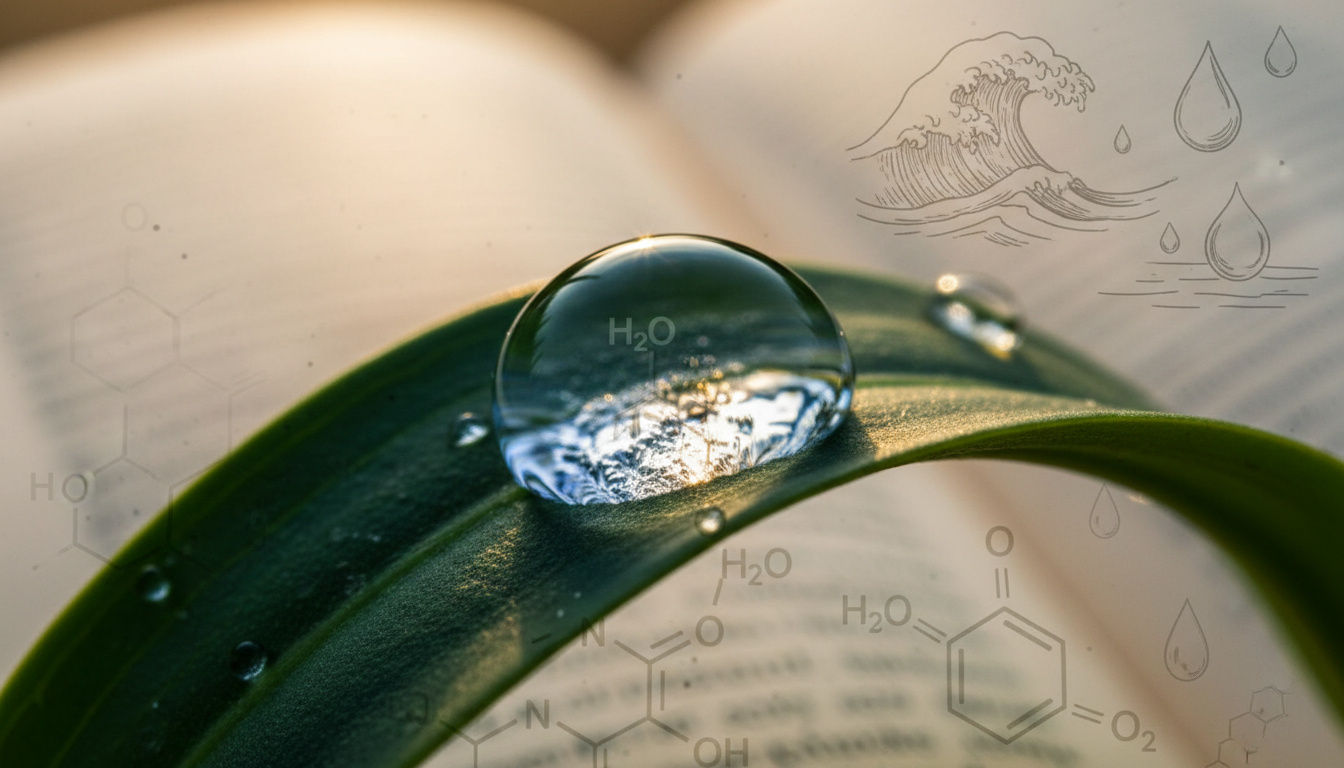
The question seems absurd at first glance. Water covers most of our planet, falls from the sky, and fills our oceans. Yet a viral debate has persisted for over a decade asking a deceptively simple question: is water wet?
The answer depends entirely on whether you consult a physics textbook or a dictionary. In laboratories, scientists define wetness as a specific interaction between liquid and solid surfaces. In everyday conversation, people describe anything liquid or moisture-laden as wet. This contradiction has fueled millions of social media posts, endless comment threads, and heated arguments among both experts and laypeople.
To settle the matter—or at least explain why it cannot be settled—we must examine surface tension, molecular adhesion, and the precise moment a dry object becomes wet.
Is Water Wet? Breaking Down the Core Debate
| Scientific View | No. Water causes wetness in other materials but cannot wet itself, as it lacks a solid substrate to adhere to. |
| Philosophical View | Yes. By sensation and composition, water comprises liquid, making it inherently wet. |
| Key Term | Wetness equals liquid adhesion to a solid surface through surface tension. |
| Viral Status | Internet meme since approximately 2010, peaking on Reddit and Twitter. |
- Physics Fact: Wetting requires a contact angle between liquid and solid; water poured on water creates no such angle.
- Dictionary Definition: Merriam-Webster defines “wet” as being covered or saturated with liquid, implying a prior dry state.
- Common Error: Confusing the sensation of moisture with the physical mechanism of wetting.
- Experimental Proof: Spill water on glass—it spreads (wetting). Pour water into water—it merges (no wetting).
- Cultural Note: The debate gained scientific credibility after popular YouTube channels explained surface physics to mass audiences.
| Question | Short Answer | Source Type |
|---|---|---|
| Is water wet? | No (scientifically) | Surface Physics |
| Is liquid water wet? | No | Molecular Chemistry |
| Is ice wet? | No (dry solid) | Material Science |
| Is steam wet? | No (dry gas) | Thermodynamics |
| Is fire wet? | N/A (not liquid) | Combustion Physics |
| Does water make itself wet? | No | Fluid Dynamics |
What Does It Mean for Something to Be Wet?
Wetness is not merely a sensation. According to BBC Science Focus, the property depends on how liquids interact with solids through adhesion and surface tension. When water touches glass, molecular forces pull the liquid across the surface, creating a film. The glass becomes wet. When water touches water, the molecules merge through hydrogen bonds, creating volume without surface interaction.
The Physics Definition: Adhesion vs. Cohesion
Surface physics hinges on two competing forces. Adhesion causes liquid molecules to stick to solid surfaces. Cohesion causes liquid molecules to stick to each other. Water on clean glass demonstrates strong adhesion, forming a continuous film. Water on wax demonstrates dominant cohesion, beading up and leaving the surface effectively dry.
The Dictionary Definition: Covered in Liquid
Common usage ignores molecular mechanics. If an object contains or is covered by liquid, English speakers call it wet. By this lexical standard, water is the essence of wetness—the standard by which we judge other substances. UCSB Science Line notes this creates three valid viewpoints: sensory (feels wet), compositional (is liquid), or process-based (has been wetted).
Dictionary definitions prioritize utility over technical accuracy. When Merriam-Webster defines “wet” as saturated with liquid, the entry describes the state of solids after liquid exposure, not the liquid itself.
Scientific Perspective: Water’s Properties and Wetness
Laboratory science offers a definitive answer, though it contradicts intuition. Water cannot be wet because wetness describes a liquid’s effect on a solid substrate. Without that solid, no wetting occurs—only merging.
Why Water Cannot Wet Itself
Pour water onto a dry sponge, and you witness wetting. The liquid adheres to the solid matrix, changing the sponge’s properties. Pour water into a glass of water, and you simply create more water. No new surface forms. No adhesion takes place. The molecules integrate through existing hydrogen bonds, maintaining the same homogeneous phase.
The Role of Contact Angles
Physicists measure wetting through contact angles. A low angle means the liquid spreads and wets the surface. A high angle means the liquid beads up, leaving the surface dry. Water on wax beads due to high contact angles. On clean glass, the angle approaches zero, creating complete wetting. Water on water has no measurable contact angle because no interface exists between liquid and solid.
Place a drop of water on a dry plate. It spreads or beads, demonstrating wetting behavior. Add that drop to a full glass of water. It disappears without altering the surface, proving water cannot wet water.
Related Questions: Is Ice Wet? Is Fire Wet?
The water debate inevitably expands to other states of matter. If liquid water cannot be wet, what about its solid form? What about plasma? Similar categorical confusion appears in biological classifications, where definitions determine measurement standards.
Is Ice Wet?
Ice is solid H₂O. By surface physics standards, ice remains dry until its surface melts. A frozen cube pulled from a freezer sublimates—transitions directly to gas—without wetting surrounding surfaces. Only when the surface liquefies does adhesion begin, allowing the ice to wet other objects.
Is Steam Wet?
Steam, or water vapor, constitutes a gas. Gases lack the surface tension and liquid structure required for wetting. Steam is dry until it condenses on a cool surface, at which point the resulting liquid water wets that surface.
Is Fire Wet?
Fire represents combustion—rapid oxidation producing plasma and hot gases. Fire is neither wet nor dry; the question applies a liquid-state property to a chemical reaction. Asking if fire is wet resembles asking if a burned object is burned—fire burns, but is not itself burned.
Applying “wetness” to fire or steam conflates states of matter. Wetness specifically describes liquid-solid interactions, making it inapplicable to gases, plasmas, or solids without liquid surfaces.
How Did the ‘Is Water Wet?’ Question Take Over the Internet?
-
Philosophy and linguistics circles debate moisture semantics academically without widespread attention.
-
The debate explodes on Reddit subreddits r/showerthoughts and r/AskScience, then spreads to Twitter, pitting “water makes things wet” against “water is wet” camps.
-
Educational YouTube channels like Vsauce produce viral videos blending physics and philosophy, garnering millions of views and cementing the question in popular culture.
-
The meme persists across TikTok and Instagram, with users conducting home experiments proving both sides, often demonstrating confusion between scientific and colloquial definitions.
What Do We Know for Certain About Water and Wetness?
| Established Information | Information That Remains Unclear |
|---|---|
| Wetness requires liquid-solid interaction through adhesion | Whether subjective sensation should override physical definitions |
| Water molecules cohere rather than adhere to themselves | If “wet” as an adjective can describe the substance itself |
| Ice and steam are dry in their pure states | Where exactly to draw the line between wet and damp sensations |
| Fire is not subject to wetness categorization | Why the debate generates such strong emotional responses |
Why Does the Definition of Wetness Matter?
Beyond internet arguments, precision in defining wetness affects materials science, chemistry, and engineering. When designing waterproof coatings or medical adhesives, engineers must know whether a surface will retain liquid film. Confusing cohesion with adhesion leads to product failures.
The debate also highlights how language evolves separately from scientific understanding. BBC Science Focus notes that ambiguity in “wetness” allows the argument to persist—different communities use the same word for different phenomena. Recognizing this semantic drift helps prevent miscommunication between technical and general audiences.
What Do Experts Say About Water Being Wet?
“Wetness is the state of being covered with water or another liquid.”
— Merriam-Webster Dictionary (Definition Analysis)
“Water makes other things wet but cannot wet itself since it merges without altering a solid.”
— UCSB Science Line
“The debate persists due to ambiguous definitions of ‘wetness’ across different fields.”
— BBC Science Focus
Final Verdict: Is Water Actually Wet?
Science provides a clear answer: water is not wet. Wetness describes a process where liquid adheres to solid, changing the solid’s state. Water cannot adhere to itself; it merges. However, in everyday English, calling water wet remains linguistically acceptable if imprecise. Is Water Wet – Science Says No, Dictionaries Say Yes captures this dual reality—physics denies wetness, while semantics accepts it. The contradiction itself illuminates how human language and natural laws operate on different, sometimes incompatible, logics.
Frequently Asked Questions
Can water be dry?
Pure H₂O in liquid form is never dry in the sense of lacking moisture, but it is dry in the scientific sense of not wetting any surface. Dehumidified water vapor approaches dryness, but strictly speaking, water as a substance contains hydrogen and oxygen in proportions that create liquidity.
Is steam wet?
No. Steam consists of water vapor, a gas. While it may feel moist or hot, the vapor itself lacks the surface tension and liquid structure required for wetness. Only when steam condenses on a cool surface does it become liquid and wet that surface.
What if water is supercooled?
Supercooled water remains liquid below freezing temperatures but behaves identically to room-temperature water regarding wetness. It still cannot wet itself, though it may freeze instantly upon contact with solids, creating ice that is technically dry until surface melting occurs.
Does water make itself wet?
No. When water contacts water, the molecules combine through cohesion, not adhesion. No wetting occurs because no solid surface exists to be wetted. The volume increases, but the property of wetness—requiring a liquid-solid interface—remains absent.
Is water wet according to dictionaries?
Dictionaries define “wet” as covered with or saturated by liquid, which technically describes objects after water exposure, not the water itself. However, the definition implies water possesses the quality it imparts, leading to the colloquial acceptance that water is wet.
Related stories


Liam O'Brien covers Australian politics and public affairs for Aussie Focus Hub.