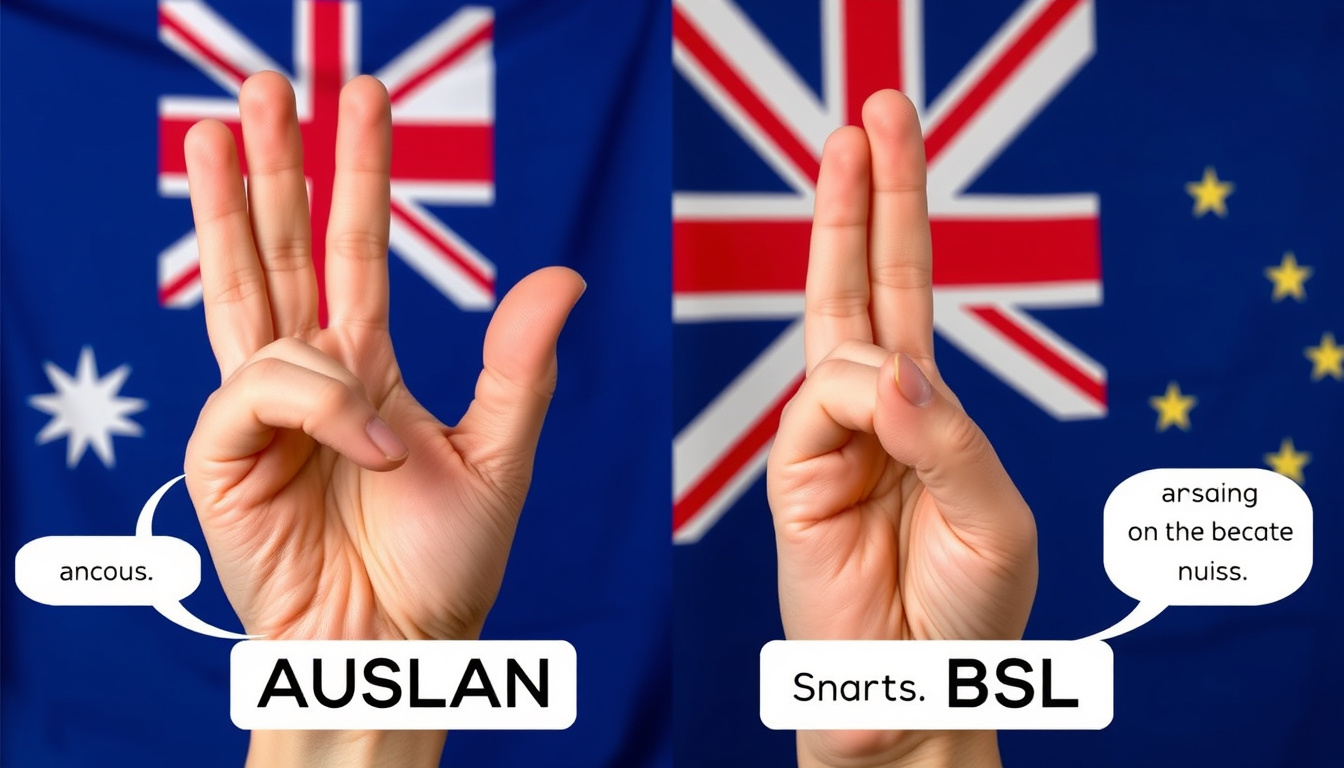
Auslan, Australia’s sign language, looks nothing like American Sign Language — it’s deeply rooted in British Sign Language yet has its own grammar and vocabulary. Officially recognized as a community language in 1987, Auslan is used by an estimated 20,000–30,000 people across the country, though precise numbers remain a matter of debate.
Official name: Auslan (Australian Sign Language) · Language family: Related to British Sign Language (BSL) and New Zealand Sign Language (NZSL) · Primary learning resource: Auslan Signbank (online dictionary) · Common greeting sign: ‘Hi’ (wave hand near forehead) · Slang example: 258 = ‘I love you’ (handshape)
Quick snapshot
- Auslan is the sign language used by the majority of the Australian Deaf community (Wikipedia (community-edited encyclopedia))
- Auslan is related to BSL and NZSL, all descending from the BANZSL family (Wikipedia)
- Auslan uses a two-handed fingerspelling alphabet similar to BSL (Superprof (language learning platform))
- Exact number of Auslan users is disputed — estimates range from 20,000 to 30,000 but no official census exists
- Whether “achoo” is a universal Deaf response to sneezing — cultural and regional variation exists
- Origin and prevalence of “lazy asl” slang remain undocumented
- Whether 258 is universally understood as “I love you” across all Auslan dialects — origin details are sparse
- 1987: Auslan recognized as a community language by the Australian government (Superprof)
- 2001: Auslan Signbank launched as a comprehensive online dictionary (Superprof)
- 2010s: Growth of online learning resources and community-led classes (Aussie Deaf Kids (support organization for deaf children))
- 2020: Deaf Connect begins offering beginner Auslan courses online (Deaf Connect (deaf-led service provider))
- Expanding online course offerings and video dictionaries from Deaf Connect and Signbank
- More community-based immersion opportunities for learners in cities and regional areas
- Growing recognition of Auslan’s unique grammar and slang in mainstream Australian culture
Quick facts table provides a reference overview of Auslan’s key attributes.
| Attribute | Value |
|---|---|
| Language name | Auslan (Australian Sign Language) |
| Language family | Related to BSL and NZSL (Wikipedia) |
| Fingerspelling | Two-handed (like BSL) |
| Estimated users | 20,000–30,000 (disputed, no precise official count) |
| Primary online resource | Auslan Signbank (online dictionary) |
| Slang example | 258 = “I love you” |
What sign language does Australia use?
Introduction to Auslan
Auslan (Australian Sign Language) is the native sign language of the Australian Deaf community. It belongs to the BANZSL language family, which also includes British Sign Language and New Zealand Sign Language (Wikipedia (community-edited encyclopedia)). Its grammar and vocabulary are distinct from spoken English — space and handshape carry grammatical meaning, according to Melbourne Polytechnic (vocational education institution).
The role of Auslan in the Australian Deaf community
Auslan is used by Deaf individuals, their families, interpreters, and educators across Australia (Superprof (language learning platform)). Two major dialects exist: a Northern dialect (Sydney and Queensland) and a Southern dialect (Victoria, South Australia, Western Australia) (Aussie Deaf Kids (support organization for deaf children)).
Learners who start with the two-handed alphabet and space-grammar rules will build a solid foundation. The dialectal split means local practice matters — signing in Melbourne may differ subtly from signing in Brisbane.
The pattern: Auslan is not monolithic — regional variation and community context shape everyday use.
Are BSL and Australian Sign Language the same?
Key differences between Auslan and BSL
While Auslan and BSL share historical roots, they are not identical. Both use two-handed fingerspelling, but the vocabulary, number systems, and grammatical use of space differ (Ryla Glyphs (deaf culture insights platform)). Melbourne Polytechnic notes that Auslan uses space grammatically, whereas BSL uses it primarily for emphasis (Melbourne Polytechnic (vocational education institution)).
Auslan has also been influenced by Indigenous sign systems and Irish Sign Language, giving it a lexicon distinct from BSL (Superprof (language learning platform)). For example, the sign for “sorry” in Auslan is different from the BSL version.
Even experienced BSL signers cannot automatically understand Auslan; regional signs and grammar create real communication barriers. Traveling between Australia and the UK for work or study requires dedicated vocabulary adaptation.
Four key features, one pattern: the languages are cousins, not siblings.
| Feature | Auslan | BSL | Source |
|---|---|---|---|
| Fingerspelling | Two-handed (both hands active) | Two-handed (both hands active) | Superprof |
| Number signs | Handshape + facial expression for numbers like 258 | Different handshapes for numbers | Melbourne Polytechnic |
| Grammatical use of space | Integral to meaning | Primarily for emphasis | Melbourne Polytechnic |
| Regional variation | Two main dialects (North/South); Indigenous influences | Regional dialects within UK | Aussie Deaf Kids |
Is Sign Language Universal Across The World?
Why sign languages are not universal
Sign languages are natural languages that develop independently within communities. American Sign Language (ASL) is completely different from Auslan and BSL (Superprof (language learning platform)). International Sign (IS) is a simplified pidgin used at global deaf events, not a full language.
Examples of different sign languages
- ASL (United States and Canada) – one-handed alphabet
- BSL (United Kingdom) – two-handed alphabet, distinct from ASL
- Auslan (Australia) – two-handed alphabet, related to BSL but separate
- NZSL (New Zealand) – shares BANZSL family with Auslan and BSL
- LSF (France) – root of ASL, different handshape system
The implication: learning Auslan does not make you fluent in ASL or any other sign language. Each requires dedicated study of its own grammar and cultural context.
How long can it take to learn Auslan?
Self-study versus formal classes
Self-study offers flexibility through resources like Auslan Signbank (online dictionary) and mobile apps, but lacks feedback on handshape accuracy and grammar. Formal classes provide structured curriculum and interaction with the Deaf community. Deaf Connect (deaf-led service provider) offers beginner courses both online and in-person.
Upsides
- Self-study: low cost, flexible schedule (Auslan Signbank)
- Self-study: access to free videos and dictionary
- Formal classes: live feedback from Deaf instructors (Deaf Connect)
- Formal classes: structured progress and community networking
Downsides
- Self-study: no corrective feedback, risk of bad habits
- Self-study: limited exposure to natural signing speed
- Formal classes: higher cost (AUD 200–600 per course)
- Formal classes: fixed schedule and location constraints
Typical learning timeline for basic conversational fluency
Basic fluency — being able to hold simple conversations — typically takes 6 to 12 months of regular study, according to multiple sources including Deaf Connect (deaf-led service provider). Advanced proficiency, including understanding cultural slang and regional variations, takes several years of immersion within the Deaf community.
- Step 1 – Learn the Auslan two-handed fingerspelling alphabet (Auslan Signbank)
- Step 2 – Master basic phrases: “Hi”, “Thank you”, “Sorry”, “How are you?”
- Step 3 – Practice with video resources on Auslan Signbank and YouTube
- Step 4 – Enroll in a beginner course with Deaf Connect
- Step 5 – Attend Deaf community events to practice conversational skills
The catch: without consistent practice and community exposure, even structured classes won’t build real-world fluency.
What is 258 in deaf slang?
Meaning and origin of 258
The numbers 2, 5, and 8 correspond to handshapes that spell “I love you” in Auslan-based number slang. The handshape for “I” is a closed fist (2 fingers?), but the cultural shorthand is widely used in Australian Deaf texting and social media. Melbourne Polytechnic (vocational education institution) notes that numbers are often signed with specific handshapes and facial expressions, which makes number-based slang natural in Auslan.
Other examples of Auslan slang and number-based signs
- 258 – “I love you” (handshape representing each digit)
- 143 – “I love you” in ASL-based number slang (less common in Auslan)
- 520 – “I love you” in Chinese number slang (used by some bilingual deaf)
- Regional variations: younger signers in Melbourne may use different number signs than older signers in Sydney (Aussie Deaf Kids (support organization for deaf children))
For learners, picking up number-based slang like 258 shows cultural fluency beyond textbook Auslan. Not understanding these shortcuts can make you miss half the conversation in social settings.
The pattern: slang like 258 reflects the living, evolving nature of Auslan within Deaf communities.
Clarity: Separating confirmed facts from what’s uncertain
Based on available sources, we can confidently state the following.
Confirmed facts
- Auslan is the sign language of the Australian Deaf community (Wikipedia)
- Auslan belongs to the same language family as BSL and NZSL (Wikipedia)
- Auslan and BSL are not identical — they differ in grammar and vocabulary (Ryla Glyphs)
- Basic conversational fluency typically requires 6–12 months of study (Deaf Connect)
What remains unclear
- Precise number of Auslan users — estimates vary and no official census exists
- Whether the “achoo” response to sneezing is universal or culturally specific
- Origin and prevalence of the slang expression “lazy asl”
- Whether 258 is universally understood across all Auslan dialects — origin details are sparse
“Auslan is the language of the deaf community in Australia. It has its own grammar and is not a signed version of English.”
— Auslan Signbank (online dictionary)
“Auslan is related to British Sign Language and New Zealand Sign Language, and the three descend from the same parent language within the BANZSL family.”
— Wikipedia (community-edited encyclopedia)
“Learners of Auslan benefit from structured courses that connect them directly with Deaf community members.”
— Deaf Connect (deaf-led service provider)
For Australian learners, the choice between self-study and formal classes is not binary. The pattern is clear: self-study provides flexibility, but formal instruction and community immersion are what build true fluency. For anyone serious about learning Auslan, the recommendation is to start with the two-handed alphabet today and sign up for a beginner course within the first month. For those already studying, attending a Deaf community event will accelerate your progress more than any app can.
Auslan, as Australia’s native sign language, shares historical ties with British Sign Language, while New Zealand Sign Language Week 2025 offers a parallel celebration of Deaf culture across the Tasman.
Frequently asked questions
Can I learn Auslan by myself?
Yes, self-study is possible using resources like Auslan Signbank and mobile apps, but you will miss real-time feedback on handshape and grammar. Combining self-study with occasional formal classes or community meetups is recommended.
How do you say ‘hi’ in Auslan?
A common greeting is to wave the hand near the forehead — similar to an informal wave but closer to the face. It can mean “hi” or “hello”.
How do aussies say ‘sorry’ in sign language?
The Auslan sign for “sorry” is made by making a fist with the dominant hand, palm facing the body, and rubbing it in a circular motion over the chest. This differs from the BSL sign.
Do deaf people say ‘achoo’ when they sneeze?
Not universally. Some Deaf individuals make a silent sneeze followed by a signed comment, while others may vocalize. Cultural norms vary within the Deaf community.
What does ‘lazy asl’ mean?
The term “lazy asl” is informal slang used by some young deaf signers to describe relaxed, informal signing. Its exact origin is unclear.
Is there a sign language Australia alphabet chart?
Yes. Auslan uses a two-handed fingerspelling alphabet. Charts are available on Auslan Signbank and many educational sites.
What is the best sign language Australia translator app?
Apps like “Auslan Dictionary” and “Signbank” are commonly recommended, but no single product is officially endorsed by the Deaf community.
How do I find Auslan classes near me?
Check with Deaf Connect for online and in-person courses across Australia. Local TAFEs and community centers also offer classes.
Related reading
- Swinburne University of Technology – offers accredited Auslan interpreting courses and community engagement programs.
- Sinhala to English Translation – explore another language pair for translation enthusiasts.

Ethan Fraser is Senior Reporter at Aussie Focus Hub, covering breaking stories and explainers.