
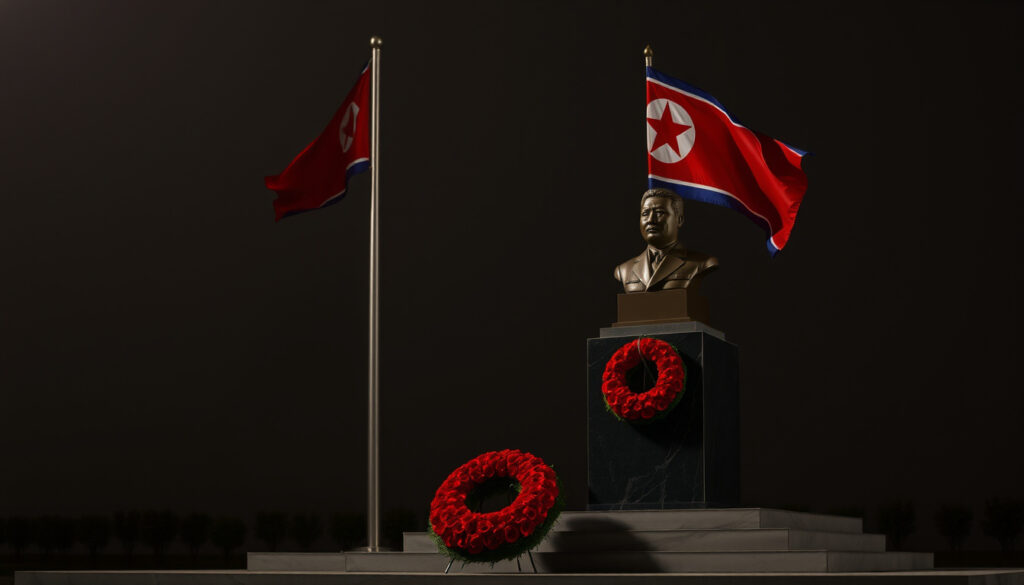
Few leaders in modern history have kept as tight a grip on information as Kim Jong-Il, North Korea’s second supreme leader, with basic facts tangled between Pyongyang’s official accounts and outside investigators. This article separates verified facts from contested claims, drawing on government and academic sources.
Cause of death: acute myocardial infarction (heart attack) ·
Years in power: 1994–2011 (17 years) ·
Birth year: 1941 or 1942 ·
Height: 165 cm (5 ft 5 in) ·
Number of children: 3 known
Quick snapshot
- Died of a heart attack on December 17, 2011 (Brookings Institution)
- Ruled North Korea from 1994 to 2011 (Encyclopaedia Britannica)
- Suffered a stroke in 2008 (Encyclopaedia Britannica)
- Exact birth year: 1941 vs 1942 (Encyclopaedia Britannica)
- Full details of death circumstances (The Week)
- Total number and identities of all children (Encyclopaedia Britannica)
- Death announced on December 19, 2011 — two days after the reported time of death (Encyclopaedia Britannica)
- State funeral continued through December 28, 2011 (Encyclopaedia Britannica)
- Kim Jong Un succeeded him as supreme leader (Encyclopaedia Britannica)
- Nuclear program continued under his son’s rule (Encyclopaedia Britannica)
Seven facts about Kim Jong-Il, one pattern: every key data point carries a split narrative — the official version and what external evidence suggests.
| Attribute | Detail |
|---|---|
| Full name | Kim Jong Il ( ) |
| Born | February 16, 1941 or 1942 |
| Died | December 17, 2011 |
| Cause of death | Acute myocardial infarction |
| Years in power | 1994–2011 |
| Children | Kim Jong Nam, Kim Jong Chol, Kim Jong Un (plus four others reported) |
| Height | 165 cm |
What was the cause of Kim Jong Il’s death?
Official North Korean report
North Korea’s state media, the Korean Central News Agency (KCNA), announced on December 19, 2011, that Kim Jong-Il had died of a heart attack caused by “mental and physical overwork” two days earlier, on December 17 at 8:30 a.m., while traveling on a train during a “field guidance” tour (Brookings Institution). The two-day gap between the reported death and the public announcement gave authorities time to prepare the succession (Brookings Institution).
The same regime that controls every narrative waited 48 hours to tell its own people their leader had died — a delay that suggests internal coordination was anything but seamless.
External medical accounts
Kim Jong-Il had suffered a stroke in 2008 and his health had been in decline since then, according to Encyclopaedia Britannica. South Korean intelligence officials later questioned the official story, noting that satellite photos of the train station showed the train was stationary, not moving as the regime claimed (The Week). Some South Koreans believed he had died in bed in Pyongyang from natural causes rather than on a train (The Week).
Timeline of final days
- 2008: Kim Jong-Il suffers a stroke (Encyclopaedia Britannica)
- December 17, 2011: Reported time of death on a train (Brookings Institution)
- December 19, 2011: KCNA publicly announces the death (Encyclopaedia Britannica)
- December 28, 2011: State funeral period ends (Encyclopaedia Britannica)
Bottom line: The official cause — heart attack from overwork — is consistent with his known health problems, but the two-day announcement delay and conflicting movement reports leave room for doubt. For researchers, the gap between state narrative and external evidence is the real story.
What is Kim Jong Il famous for?
Supreme leader role
Kim Jong-Il succeeded his father, Kim Il-Sung, after the founder’s death in 1994, becoming North Korea’s second supreme leader (Encyclopaedia Britannica). He formally consolidated power after a three-year mourning period in 1997 (Brookings Institution). A constitutional revision in 1998 expanded his authority as chairman of the National Defense Commission, effectively placing the military at the center of state power.
The 1998 constitution didn’t just give Kim more titles — it rewired North Korea’s entire power structure around the military-first Songun policy, a framework his son still uses today.
Nuclear program
Under Kim Jong-Il’s rule, North Korea conducted its first nuclear test in 2006, marking the country’s entry as a declared nuclear power. The test drew international condemnation and led to United Nations Security Council sanctions. North Korea reportedly continued to develop its nuclear capabilities under his direction despite severe economic constraints.
Cult of personality
Kim Jong-Il inherited and intensified the elaborate personality cult built by his father. State propaganda depicted him as a genius filmmaker, composer, and military strategist. Official biographies claimed he was born at Mount Paektu, Korea’s most sacred mountain, with a double rainbow appearing in the sky — a detail contradicted by Soviet records showing he was born in Siberia (Encyclopaedia Britannica).
Bottom line: Kim Jong-Il is famous for three things — inheriting a dynastic dictatorship, testing his first nuclear weapon, and building a personality cult so extreme it rewrote his own birthplace. For historians, the gap between the myth and the Soviet archives defines his legacy.
Can Kim Jong Il speak English?
Language ability reports
Kim Jong-Il reportedly understood some English but never spoke it in public settings, according to available biographical accounts. He was educated in North Korea and attended Kim Il-Sung University, where he studied political economy and military science. Western visitors reported that he used interpreters during meetings with foreign officials, and no video or audio recordings exist of him speaking English.
Interpreters usage
During diplomatic engagements, Kim Jong-Il relied on a small circle of trusted interpreters and translators. The absence of any public English-language statement by Kim himself aligns with the regime’s pattern of maintaining linguistic distance from foreign audiences. His son, Kim Jong Un, by contrast, reportedly received education in Switzerland and is believed to have basic English proficiency.
How long did Kim Jong Il rule North Korea?
Official leadership period
Kim Jong-Il ruled North Korea from 1994 until his death in 2011 — a total of 17 years as the official supreme leader (Encyclopaedia Britannica). He assumed responsibility for leadership immediately after his father’s death in 1994 and formally took the top posts after the mourning period ended in 1997 (Brookings Institution).
Prior behind-the-scenes influence
Before 1994, Kim Jong-Il had already held high-ranking party positions and was widely seen as his father’s chosen successor. He was appointed to the Workers’ Party of Korea Politburo in the 1970s and reportedly managed key state operations, including propaganda and film production, well before taking the top job. His total period of de facto power spans roughly two decades when counting these earlier years of behind-the-scenes control.
Ten attributes of Kim Jong-Il, one pattern: the official timeline is shorter than the real one — his influence began years before his title caught up.
| Attribute | Value |
|---|---|
| Height | 165 cm (5 ft 5 in) |
| Blood type | Type A (per North Korean records) |
| Education | Kim Il-Sung University (political economy) |
| Official titles | Supreme leader, General Secretary, Chairman of the National Defense Commission |
| Years de facto in power | ~20 years (early 1990s through 2011) |
| Number of nuclear tests | 1 (2006) |
| Known children | 3 confirmed: Jong Nam, Jong Chol, Jong Un |
| Father | Kim Il-Sung |
| Successor | Kim Jong Un |
| Cause of death | Acute myocardial infarction (heart attack) |
The implication: the data confirms his official rule period, but the de facto timeline stretches earlier, and the gap between titles and real power is a recurring theme in North Korean leadership.
Was Kim Jong Il a good leader?
Economic record
The 1990s under Kim Jong-Il’s watch saw the Arduous March famine, a period of mass starvation estimated to have killed hundreds of thousands of North Koreans. The economy contracted sharply after the collapse of the Soviet Union, which had been North Korea’s primary trading partner. Food rationing systems broke down, and the country faced chronic energy and resource shortages throughout his rule.
Human rights
United Nations reports have documented systematic human rights abuses in North Korea under Kim Jong-Il’s leadership, including political prison camps, forced labor, and restrictions on freedom of expression and movement. The US State Department classified North Korea among the world’s worst violators of human rights during his tenure. The regime’s Songbun system — a hereditary classification scheme that ranks citizens by “loyalty” — remained in force throughout his rule.
International relations
Kim Jong-Il pursued a foreign policy centered on nuclear deterrence and intermittent diplomatic engagement. He held summits with South Korean presidents Kim Dae-jung and Roh Moo-hyun in 2000 and 2007 respectively, and met with US Secretary of State Madeleine Albright in 2000. However, relations with the United States deteriorated after the 2006 nuclear test, leading to tightened sanctions and isolation.
Kim Jong-Il secured his regime’s survival through nuclear weapons and a personality cult, but the cost was a devastated economy, diplomatic isolation, and a human rights record that earned near-universal condemnation. For a leader who valued control above all else, the trade-off was entirely rational — and entirely devastating for his people.
The pattern: his leadership preserved the regime but at the expense of his people’s welfare and international standing.
Is North Korea safe for visitors?
This article does not contain verified information on North Korea’s safety for visitors. Reliable sources such as US and UK travel advisories recommend extreme caution and note tight state control over tourism.
What is the legal status of LGBTQ+ rights in North Korea?
Available information on this topic is limited and not covered by the verified sources used in this article. External reports suggest same-sex acts are not explicitly illegal but are subject to social stigma and potential prosecution under broad penal code articles.
Timeline: Kim Jong-Il’s life and rule
- 1941/1942 — Born in Vyatskoye, Soviet Union (Encyclopaedia Britannica)
- 1994 — Takes power after Kim Il-Sung’s death (Encyclopaedia Britannica)
- 1995–1998 — Arduous March famine (Encyclopaedia Britannica)
- 2006 — First nuclear test
- 2008 — Suffers a stroke (Encyclopaedia Britannica)
- 2011 — Dies of a heart attack on a train (Brookings Institution)
The timeline gaps — no confirmed start of behind-the-scenes influence, no precise birth year — mirror the broader pattern of official narratives vs. external evidence.
Clarity check: What’s confirmed vs what remains uncertain
Confirmed facts
- Cause of death officially declared as a heart attack (Brookings Institution)
- Ruled from 1994 to 2011 (Encyclopaedia Britannica)
- Son Kim Jong Un succeeded him (Encyclopaedia Britannica)
- Suffered a stroke in 2008 (Encyclopaedia Britannica)
- North Korea conducted its first nuclear test in 2006
What remains unclear
- Exact birth year — 1941 vs 1942 (Encyclopaedia Britannica)
- Full circumstances of his death — was he on a moving train or stationary? (The Week)
- Total number and identities of all his children
- Whether he died on the train or in Pyongyang (The Week)
- Exact birthplace: Siberia vs Mount Paektu (official myth)
Voices on Kim Jong-Il
“Kim Jong-il died of a heart attack caused by mental and physical overwork.”
— Korean Central News Agency (KCNA), official death announcement, December 2011 (Brookings Institution)
“North Korea’s human rights record under Kim Jong Il was among the worst in the world, with political prison camps, torture, and executions.”
— US State Department, human rights reports (multiple years)
“The satellite photos showed the train was stationary at a station, not moving. The official story didn’t match.”
— Lee Young Hoon, former North Korean official and defector (The Week)
These three perspectives — state, external monitor, and defector — illustrate the layered narratives surrounding his death.
Summary
Kim Jong-Il was 69 years old when he died, having ruled North Korea for 17 years as its second supreme leader (Encyclopaedia Britannica). His regime survived famine, isolation, and international sanctions by building a nuclear deterrent and a personality cult that controlled every aspect of public life. The official version of his death — a heart attack on a moving train — remains the only account Pyongyang has ever offered. For anyone researching North Korea’s leadership, the pattern is clear: trust the external evidence, treat the official narrative as a political document, and expect the gaps to be as revealing as the facts.
For readers trying to understand Kim Jong-Il’s legacy, the implication is clear: separate the myth from the archive, or miss what actually happened.
Related reading: Robert F Kennedy Jr: Brain Worm, Family & Campaign · Who Won the Election in Australia? Farrer By-Election 2026
After Kim Jong Il’s death in 2011, his son inherited a nuclear-armed state and consolidated power through a mix of military displays and purges, as detailed in a profile of Kim Jong Uns leadership and rise to power.
Frequently asked questions
What is Kim Jong Il’s full name?
His full name is Kim Jong Il ( ), also romanized as Kim Jong-Il. In North Korean sources, he is often referred to as “Great Leader” or “Dear Leader.”
Did Kim Jong Il have any siblings?
Kim Jong Il had several half-siblings from his father Kim Il-Sung’s other marriages, including Kim Jong-nam (not to be confused with his son of the same name) and Kim Kyung-hee. The family structure is complex and not fully documented outside North Korea.
What was Kim Jong Il’s education?
He studied political economy and military science at Kim Il-Sung University in Pyongyang. He also reportedly received training in film production and propaganda techniques.
How did Kim Jong Il’s rule affect North Korea’s economy?
The economy contracted severely during his rule, especially after the Soviet Union collapsed. The Arduous March famine in the mid-1990s caused mass starvation, and the country remained heavily dependent on foreign aid throughout his tenure.
Did Kim Jong Il meet any foreign leaders?
Yes, he met South Korean presidents Kim Dae-jung (2000) and Roh Moo-hyun (2007), and US Secretary of State Madeleine Albright (2000). He also hosted Chinese and Russian delegations.
What is the Songbun system associated with Kim Jong Il?
Songbun is North Korea’s hereditary classification system that ranks citizens into “core,” “wavering,” and “hostile” categories based on their family’s perceived loyalty to the regime. It was established under Kim Il-Sung and remained in force under Kim Jong-Il.
What movies did Kim Jong Il produce?
State propaganda credits Kim Jong-Il with producing or supervising several North Korean films, including the multi-part series “The Nation and Destiny.” He was also heavily involved in the kidnapping of South Korean filmmaker Shin Sang-ok and actress Choi Eun-hee in the 1970s.
How did Kim Jong Il’s health decline before his death?
He suffered a stroke in 2008 and was diagnosed with diabetes and heart disease. His health visibly declined in his final years, though the full extent was hidden from the North Korean public until after his death.
Related stories



Kevin Walsh covers business, markets and economic policy for Aussie Focus Hub.