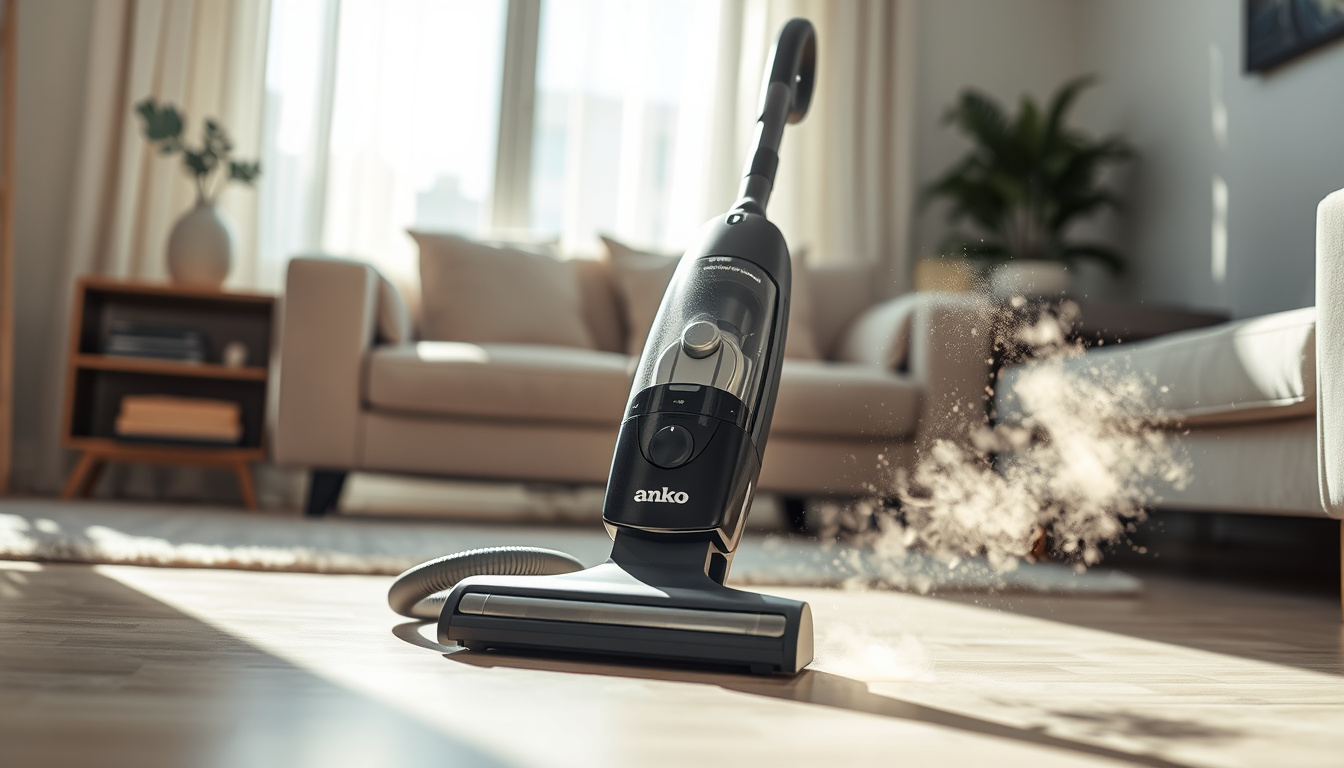
Anyone who’s hunted for a vacuum under $100 knows the pitch: comparable suction, a fraction of the price. Kmart’s Anko range makes exactly that promise — and for many buyers, it delivers just enough to get by. But the fine print in independent lab tests tells a different story than the star ratings on the product page.
CHOICE Expert Rating (Anko 2-in-1): 67% ·
Anko 2-in-1 Price: $79 ·
2400W Bagless Dimensions: 44.3cm (L) x 32cm (H) x 28.4cm (W) ·
Corded Stick Power: 600W motor ·
User Complaint (Reddit): Poor suction on crumbs
Quick snapshot
- Anko 2-in-1 cordless earns 67% CHOICE rating (CHOICE)
- Anko robot vacuum scores just 36% — lowest in tests (CHOICE)
- 2400W Bagless holds 3.1/5 stars from 168 reviews (ProductReview.com.au)
- Long-term durability beyond 12 months
- Exact manufacturing location
- Current stock status for discontinued models
- CHOICE robot review updated 2 Feb 2026 (Consumer NZ)
- Consumer NZ tested models in recent months (Consumer NZ)
- One YouTuber reports cordless decline at 12 months (YouTube)
- CHOICE: comparable brands often score 75-85% at only marginally higher prices (CHOICE)
- Consumer NZ recommends $99 Anko over pricier Anko models for better carpet movement (Consumer NZ)
- Anko cordless works 5 mins after 5-hour charge per user reports (ProductReview)
| Spec | Value |
|---|---|
| Brand | Anko (Kmart) |
| Top Model Rating | 67% (CHOICE) |
| Entry Price | $79 |
| Power Range | 600W to 2400W |
| Common Filter | HEPA / Cyclonic |
Are Anko vacuums good value for money?
The short answer from independent testers is: not particularly. Priced at $79, the Anko 2-in-1 cordless V8260-12A model performed OK overall, earning a CHOICE Expert Rating of 67%. That places Anko stick models in the lower half of stick vacuum rankings, where comparable brands often score 75-85% at only marginally higher prices.
CHOICE test results
CHOICE lab testing covers carpet cleaning, hard floor performance, edges and corners, dust re-emission, ease of use, and durability. The Anko 2-in-1 cordless lost points for lacking a power head, having no dedicated hard floor tool, and producing a messy bin emptying experience. It earned just 1 year warranty — shorter than most competitors offering 2-5 years.
Australia’s consumer watchdog noted in 2021 that Kmart vacuums averaged 3/5 stars for customer satisfaction — placing them below most major brands in owner experience.
Price vs performance
Consumer NZ took a different angle, recommending the $99 Anko 2-in-1 Cordless Stick over pricier $139 and $189 Anko models — the cheaper option moves more easily on carpet. That suggests the premium Anko models offer diminishing returns, not extra quality. Across the Tasman, Canstar Blue lists Anko’s full Australian range from $32 (2-in-1 Corded Stick) to $79 (2200W Bagless), with prices that sound reasonable until you factor in what you’re giving up.
The pattern is consistent: you get what you pay for with Anko stick vacuums, according to CHOICE testing data. The affordability is real, but so is the performance gap.
Should you buy an Anko vacuum cleaner from Kmart or Target?
This is less a comparison of brands and more a question of trade-offs. Target stocks vacuums from major manufacturers with established service networks; Kmart offers lower entry prices but thinner support infrastructure.
Availability and models
Kmart’s Anko line spans several form factors: the 2-in-1 cordless stick, a corded stick at $32, wet/dry hand vac at $49, 2000W bagless at $49, and 2200W bagless at $79. Target’s vacuum section skews toward established brands — ElectriQ, Miele-adjacent lines, and occasional own-brand offerings. The practical difference: Target vacuums typically come with 2-year warranties backed by local service agents; Anko offers 1 year with support dependent on store returns.
User feedback differences
Real-world reviews tell a split story. ProductReview.com.au users report that some Anko cordless units stopped holding charge after a few months — one noted the vacuum worked only 5 minutes after a 5-hour charge. CHOICE Community members describe Anko vacs as light and easy to maneuver but poor on suction for wood floors and rugs. The contrast with Target’s warranty-backed brands is stark in durability forums.
For Australian buyers, Kmart’s return policy covers manufacturing defects within weeks of purchase — but a vacuum that fails at 14 months falls outside that window and leaves you with a $79 paperweight.
Is the Anko 2400W bagless vacuum any good?
The 2400W Bagless model sits in the mid-range of Kmart’s lineup, offering barrel-style design with cyclonic filtration at a price point that catches attention. Its $79 sticker price undercuts equivalent Dyson barrel models by $200 or more.
Specs overview
Physical dimensions measure 44.3cm long by 32cm high by 28.4cm wide — compact enough for most Australian cupboards. The 2400W rating refers to input power, not necessarily suction pressure, which is a common marketing distinction that independent tests address directly.
| Specification | Anko 2400W Bagless | Typical mid-range barrel |
|---|---|---|
| Price | $79 | $250-$400 |
| Power rating | 2400W | 1400-2000W |
| Filtration | Cyclonic | Cyclonic + HEPA |
| Warranty | 1 year | 2-3 years |
| User rating | 3.1/5 (168 reviews) | 3.8-4.2/5 |
| Bin capacity | Not specified | 1.5-2L typical |
Cleaning performance
The ProductReview.com.au aggregate shows 3.1/5 stars from 168 verified reviews — an alternate listing puts it at 3.3/5 from 160 reviews. That’s below the 3.5+ threshold consumers typically consider acceptable. Common complaints centre on suction power declining after 6-12 months, a pattern consistent across multiple Anko vacuum types according to long-term user reports.
Australian user forums suggest the 2400W bagless model loses suction after repeated use — the cyclonic system may not maintain separation between fine dust and airflow over time without regular filter maintenance.
How to empty a Kmart vacuum?
Most Anko vacuums use a bagless design with a removable dust bin. The process varies slightly between stick and barrel models but follows the same logic: release the bin, empty over a bin or outside, check the filter, reassemble.
Step-by-step process
- Switch off and unplug the vacuum. For cordless models, confirm the motor has stopped before opening the bin.
- Locate the bin release latch — usually on the front or side of the main body. Press and hold while pulling the bin away from the motor unit.
- Carry the bin directly to an outdoor bin or well-ventilated area. Tilt the bin opening downward and let debris fall under gravity. Tap the sides to dislodge packed material.
- For stubborn residue: rinse the bin under lukewarm water. Avoid soap in the first rinse — soap residue affects dust adhesion in cyclonic systems. Dry completely before reassembly.
- Remove the filter cartridge (mesh pre-filter and HEPA post-filter where fitted). Tap loose dust into a bin. Rinse mesh filter under running water; replace HEPA if visibly collapsed or discoloured.
- Reassemble in reverse order, ensuring all seals seat properly. A misaligned seal causes suction loss — listen for air leaks on first use.
Maintenance tips
CHOICE testing noted the Anko 2-in-1 cordless has a “messy bin” experience — meaning dust escapes during emptying more than on better-designed competitors. Users report that the mesh filter is finer than some comparable brands, per independent YouTube analysis. Maintaining that filter integrity through regular (not just occasional) cleaning prevents the suction decline owners report at 6-12 months.
Do Anko vacuums have good suction?
Independent lab tests and real-world reports diverge on this question — and the gap matters for anyone considering an Anko as their primary vacuum.
Lab vs user reports
CHOICE lab testing measures suction indirectly through dust pick-up on standard surfaces. For the Anko robot vacuum (36% rating), hard floor cleaning scored 58% — meaning it collected just over half of a 200g sand test load in 25 minutes. Carpet performance dropped to 9%, and pet hair pickup reached 20%. These aren’t comparison outliers; the next-lowest robot scored 55%. The robot also failed on edges and corners (40%) and left water residue when mopping (20%).
Real-world Reddit reports align with CHOICE’s carpet findings: “The suction is shit and it’s barely able to pick up tiny crumbs,” noted one CHOICE Community user describing their Kmart stick vacuum. ProductReview users report the cordless spitting fine debris back onto floors rather than containing it in the bin.
Cyclonic filtration
The Anko corded stick includes a cyclonic filtration system — a design that separates debris from airflow through centrifugal force rather than bag filtration. Cyclonic systems maintain suction as the bin fills, but they require the separation chamber to stay clean. When the cyclonic cone fills with fine dust, performance degrades toward bagless-style suction loss. YouTube teardowns show the Anko’s mesh filter is finer than some competitors, which extends dust separation but requires more frequent cleaning to maintain airflow.
Cyclonic filtration works best in machines users maintain diligently — tapping out filters after each use, rinsing monthly. Anko buyers choosing the budget option for convenience often skip this maintenance, which is precisely when suction problems emerge.
Confirmed
- Anko 2-in-1 cordless earns 67% CHOICE Expert Rating
- Anko robot vacuum scores 36% — lowest in any recent test
- 2400W Bagless holds 3.1/5 from 168 ProductReview ratings
- Consumer NZ recommends $99 Anko over pricier Anko sticks
- Kmart vacuums scored 3/5 Canstar Blue satisfaction in 2021
- Anko robot review updated 2 February 2026
Unclear / User reports
- Long-term durability beyond 12 months unverified
- Battery life decline pattern based on anecdotal YouTube reports
- Manufacturing location not disclosed by Kmart
- V8260-12A discontinuation status unconfirmed
- Fine debris suction loss at 6-12 months — tier3 reports only
“Unfortunately, the Anko bot’s low price is the only attractive thing about it — it’s one of the worst performing robot vacs we’ve ever tested.”
— Adrian, CHOICE (Australia’s independent consumer advocate)
“So many of the newer models are getting smarter and more sophisticated, but this one is extremely basic and cleans poorly. Essentially, its tech feels similar to robot vacuums from five years ago, maybe even longer.”
— Adrian, CHOICE
“I have a kmart stick vacuum and I hate it. The bin is so small and gets clogged easily. The suction is shit.”
— Reddit user, via CHOICE Community
Related reading: Should you buy a Kmart Anko vacuum cleaner · Should you buy Kmart’s Anko robot vacuum
Kmart Anko vacuums deliver solid budget performance, especially alongside Canstar Blue’s top picks that lead Australia’s consumer ratings for 2025.
Frequently asked questions
What is the best budget vacuum cleaner?
Based on CHOICE lab testing, budget vacuums under $100 generally underperform mid-range alternatives by 15-20 percentage points in overall rating. The Anko 2-in-1 at 67% sits slightly below the average budget score, while brands like Bissell and ElectriQ offer marginally better performance at $120-180. For Australian buyers on a strict budget, the $99 Anko 2-in-1 Cordless Stick (Consumer NZ recommendation) represents the better-value Anko option, though upgrading to a $150 model typically yields significant practical improvements in suction and build quality.
How long will an Anko vacuum last?
Independent data on Anko longevity is limited. One YouTube reviewer documented strong performance for the first 6 months followed by measurable decline at 12 months on their cordless unit. CHOICE assigns a 1-year warranty, shorter than the 2-5 year standard from competitors. User reports on ProductReview and CHOICE Community describe failures occurring between 6-18 months of regular use. The honest answer: expect 12-18 months of light use, possibly less for daily carpet vacuuming.
Are Anko products good quality?
“Good quality” depends on what you’re measuring. Anko products offer functional quality — they generally work as advertised for basic tasks. Build quality, measured by durability and long-term performance, rates lower. CHOICE testing found Anko robot vacuums scored 36% with tech described as “like 5+ years ago.” The 3.1/5 ProductReview rating for the 2400W Bagless and consistent user complaints about suction decline suggest materials and engineering sit below mainstream competitors. For occasional light cleaning, Anko is adequate; for demanding households, better options exist.
Where are Kmart Anko products made?
Kmart does not publicly disclose the manufacturing origin of Anko products. Anko is a Kmart house brand distributed exclusively through Kmart stores in Australia and New Zealand. Without official supply chain transparency from Kmart, specific country of manufacture remains unverified in public sources. The brand focuses on basic function at low prices rather than emphasising origin or manufacturing standards.
How to turn on an Anko vacuum?
Most Anko stick vacuums use a simple power switch on the handle or main body. Cordless models typically require pressing a power button (often with a battery indicator LED) before the trigger activates the motor. The 2-in-1 cordless features a touchscreen control panel on the handle, per YouTube analysis, with power and mode selection. Always ensure the dust bin is properly seated before switching on — an unseated bin triggers a safety cutout on some models.
What is the Anko vacuum cleaner price?
Anko vacuum prices on Kmart.com.au range from approximately $32 for the 2-in-1 Corded Stick to $79 for the 2200W Bagless and 2-in-1 Cordless V8260-12A. The Anko Robot Vacuum retails around $169. Prices fluctuate with Kmart promotions and may differ between online and in-store stock. New Zealand pricing runs slightly higher — Consumer NZ references a $99 price point for the 2-in-1 Cordless Stick.
Are there cordless vacuum cleaners under $50 at Kmart?
Kmart’s current Anko cordless lineup starts at $79 for the 2-in-1 Cordless Stick V8260-12A. Cordless models under $50 are not currently listed in Kmart’s Australian online range. The $32 option is the 2-in-1 Corded Stick — requiring a power outlet but offering 600W motor power without battery constraints. For cordless options under $50, alternatives like Aldi special buys or online-only brands on eBay may be worth exploring, though quality variance is significant below this price point.

Andrew Patel leads fact-checking, source verification and corrections at Aussie Focus Hub.