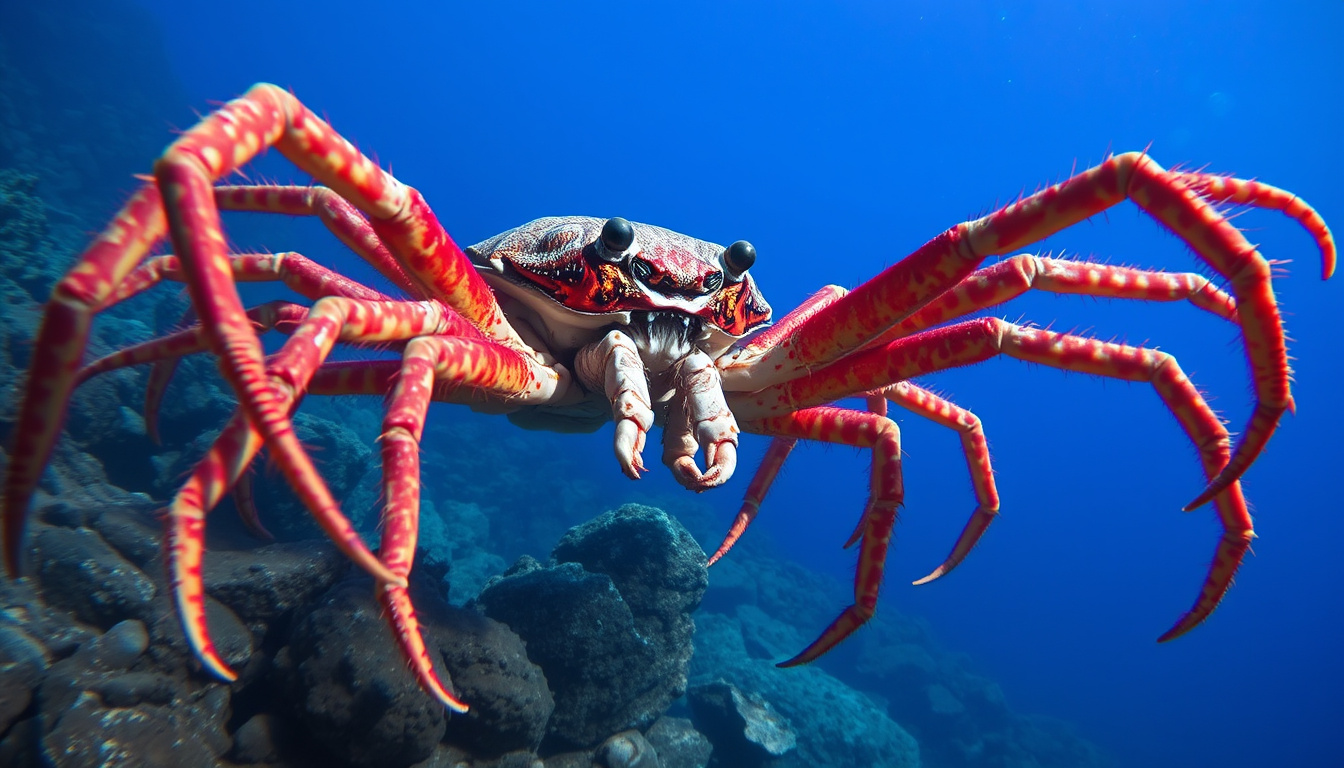
Japanese spider crabs look like nightmare creatures pulled from deep ocean horror films—yet these leg-span giants are among the most docile invertebrates in captivity, and they taste like premium crab when prepared correctly. The disconnect between their terrifying appearance and gentle reality makes them a case study in how badly humans misjudge marine life.
Leg span: up to 12.5 feet · Body width: up to 16 inches · Habitat: coastal waters of Japan · Diet: scavenger · Status: not rare in habitat
Quick snapshot
- Exact lifespan beyond estimates of 50–100 years
- Quality variation in crab meat across regions
- Fishery peaked at 24.7 tonnes in 1976, dropped to 3.2 tonnes by 1985
- Catching restrictions introduced during spring mating season
- Continued conservation measures to prevent overharvesting
- Aquarium populations aging; fewer juveniles entering display
| Attribute | Value |
|---|---|
| Scientific name | Macrocheira kaempferi |
| Max leg span | 3.75 m (12.5 ft) |
| Carapace width | 40 cm (16 in) |
| Depth range | 150–800 ft |
| Diet type | Scavenger |
Is a Japanese spider crab harmless?
Yes—and that surprises a lot of people given their imposing size. Despite leg spans that can reach 3.75 meters (12.5 feet), these crabs are scavengers that pose virtually no danger to humans. Aquariums that house them report no attacks on people, and no verified incidents of aggressive behavior exist in the scientific literature.
Can Japanese spider crab hurt humans?
The claws are strong and can deliver a pinch, but the injury risk is low. Temminck, who originally described the species, noted the claws could cause serious injuries—but that was in a historical context focused on handling wild-caught specimens. In controlled aquarium settings, staff work around the crabs without incident. The real threat isn’t aggression; it’s accidental contact with those long, spindly legs during feeding or tank maintenance.
Can a Japanese spider crab hurt you?
The same pinch risks apply to visitors at touch tanks where aquariums allow close observation. The Monterey Bay Aquarium notes that their exhibits have maintained safety records despite housing these giants, because the crabs show no predatory behavior toward humans.
Can Japanese spider crabs kill you?
No documented case exists of a Japanese spider crab killing a human. Their diet consists of algae, plant matter, molluscs, and dead fish—they’re not predators hunting larger animals. The Monterey Bay Aquarium (a leading marine research institution) confirms their gentle disposition, and multiple aquariums worldwide have kept them in touch-friendly exhibits where visitors view them at close range safely.
The claws can deliver a painful pinch if the crab feels cornered. If one grabs you, stay calm—sudden jerking can trigger a pincer reflex. Slowly submerging your hand in water often causes the crab to release.
How big is the biggest Japanese spider crab?
The Japanese spider crab holds the record for largest arthropod by leg span. The verified maximum is 3.75 meters (12.5 feet) from claw to claw, with a body carapace width reaching 40 centimeters (16 inches) and a total weight up to 19 kilograms (42 pounds).
Japanese spider crab size
Most specimens caught commercially measure 1.0–1.2 meters (3.3–3.9 feet) in leg span. The giant specimens people see in aquariums are exceptional individuals that have survived and continued growing for decades. According to the Smithsonian Ocean portal, leg spans can reach 13 feet (4 meters) in the largest individuals, with an average weight of 16–20 kg.
Japanese spider crab compared to human
A full-grown Japanese spider crab with maximum leg span would extend from head to toe of a tall adult—and then some. The famous specimen “Big Daddy,” who lived at Sea Life Blackpool, measured 3.11 meters (10.2 feet) leg span, making him roughly the length of a large sedan. His longest single leg measured 1.43 meters (4 feet 8.5 inches). When photographed next to a human, the visual effect is startling because the crab’s body looks small relative to those enormous limbs.
Stuart Blackman, author at Discover Wildlife (specialist natural history publication)
“The biggest crab in the world has to be the Japanese spider crab.”
For context: if you stretched out a Japanese spider crab’s legs and placed it beside an NBA player, the crab would overhang the basketball court by several feet on each side. The body itself is modest—the legs make the size.
Can Japanese spider crab be eaten?
Yes, and in Japan they’re considered a delicacy. The meat tastes similar to other premium crabs—sweet and firm, comparable to Dungeness or blue crab—though some who have tried it report it’s not the absolute top tier of crab flavor. The crabs are harvested occasionally using small trawling nets, primarily in Suruga Bay, and command prices reportedly ranging from $100 to $500 per crab on the open market.
Has anyone ever eaten a Japanese spider crab?
Yes, particularly in Japan where they appear on menus at upscale seafood restaurants. Preparation follows standard crab-cooking methods: steam or boil for 20–30 minutes, then chill in ice water to make meat removal easier. The Honest Food blog (a respected cooking publication) details the process and notes that the feathery gills are toxic and must be removed before eating—a critical safety step that should never be skipped.
Japanese spider crab edible
The edible portions are the leg meat and body meat, similar to other large crabs. However, because these are scavengers that eat dead matter from the ocean floor, there is a theoretical risk of toxin accumulation—particularly in wild-caught specimens. Farmed crabs raised in controlled conditions eliminate this concern. The Monterey Bay Aquarium notes that in their exhibits, the crabs are not harvested for food; they’re kept for educational display purposes only.
Japanese spider crab meat
The meat texture is firm and flaky when properly cooked, with a sweetness comparable to other premium crab species. However, some seafood enthusiasts note it falls slightly below peak Dungeness or king crab in flavor depth.
The gills (called “gill filters” or “feathery gills”) of Japanese spider crabs contain toxins that can cause illness if consumed. Always ensure complete gill removal before preparation.
Are Japanese spider crabs rare?
Not in their natural habitat. Japanese spider crabs are common in the coastal waters around Japan, particularly southern Honshū from Tokyo Bay to Kagoshima, with populations also found off Iwate Prefecture and Su-ao, Taiwan. They are not classified as endangered, though their numbers have been affected by historical overfishing.
Japanese spider crab lifespan
Estimates place their lifespan at 50–100 years, with the Monterey Bay Aquarium (an authoritative marine institution) citing figures in this range. One of the remarkable biological traits: the carapace stops growing in adulthood, but the legs continue to lengthen throughout life. This means older crabs have increasingly long legs relative to their body size.
The famous specimen Big Daddy arrived at Sea Life Blackpool from Japan in 2013 and died in 2016 at approximately 80 years old, providing one data point for longevity estimates. Guinness World Records (official record-keeping body) documented his journey and death.
The pattern here is telling: crabs that survive to old age become increasingly impressive in leg span, which explains why museum specimens and aquarium stars often measure well above average.
What to do if a crab grabs you?
If a Japanese spider crab pinches you, remain calm—sudden jerking movements can trigger a stronger pincer reflex. Slowly lowering your hand into nearby water often causes the crab to release its grip, as submersion is an environmental cue that prompts the release behavior. Do not attempt to forcibly pry the claw open, as this may injure you and stress the animal.
What does a Japanese spider crab eat?
They are omnivorous scavengers. Their diet includes algae, plant matter, molluscs, worms, and dead fish. They play an important ecological role in cleaning the ocean floor. Unlike active predators, they roam slowly across mud floors at depths between 150 and 800 feet, using their keen sense of smell to locate decaying organic matter. In aquariums, they are fed a varied diet of fish, shrimp, and squid.
Their Japanese name is taka-ashi-gani, meaning “tall-legged crab.” They often decorate their shells with sponges for camouflage, mimicking the ocean floor’s appearance to avoid detection by predators.
Can a crab hear you?
Crabs detect vibrations rather than sound waves as humans understand them. They have sensory hairs and organs that pick up movement in water. There’s no evidence they respond to human voices or distinguish individual speakers. They would sense vibrations from swimming movements, tank vibrations, or tapping on glass—but normal conversation would be irrelevant to them.
| Specification | Detail |
|---|---|
| Max leg span | 3.75 m (12.5 ft) |
| Carapace width | 40 cm (16 in) |
| Maximum weight | 19 kg (42 lb) |
| Depth range | 150–800 ft |
| Preferred depth | ~300 ft at 10°C |
| Water temperature | 6–16°C (aquarium: 10–13°C) |
| Diet | Algae, plant matter, molluscs, dead fish |
| Lifespan estimate | 50–100 years |
| Molting duration | ~100 minutes |
| Carapace shape | Pear-shaped, covered in tubercles |
| Habitat | Southern Honshū, Taiwan |
| Fishery peak | 24.7 tonnes (1976) |
These biological parameters shape every interaction aquariums have with the species, from housing conditions to feeding schedules to visitor safety protocols.
How to prepare and cook Japanese spider crab
If you obtain a Japanese spider crab for eating—typically through specialty seafood suppliers—proper preparation is essential for both safety and flavor.
- Step 1: Remove the gills. The feathery gills on each side of the carapace are toxic and must be completely removed before cooking or eating.
- Step 2: Clean the crab. Rinse the crab in cold seawater or salted water to remove debris and sand from the crevices between legs.
- Step 3: Steam or boil. Cooking time is 20–30 minutes depending on size. The crab is done when the shell turns orange-red and the meat pulls away easily from the joints.
- Step 4: Ice bath. Immediately plunge the cooked crab into ice water for 10–15 minutes. This stops the cooking process and makes the meat easier to extract from the shell.
- Step 5: Extract and serve. Remove leg segments and crack carefully to extract the meat. Serve with drawn butter, lemon, or incorporate into crab cakes or salads.
The ice bath step is critical—skipping it results in rubbery, overcooked meat that is difficult to extract. Professional crab cooks insist on this step for a reason.
Upsides
- Edible and considered a delicacy in Japan
- Sweet, firm meat comparable to premium crabs
- Significant historical fishery supporting coastal communities
- Not endangered; populations stable with conservation measures
Downsides
- Gill removal is essential and tricky for amateurs
- Scavenger diet raises theoretical toxin concerns in wild specimens
- Price range ($100–$500) puts it beyond casual consumption
- Very long legs make them awkward to prepare at home
Temminck, original species describer, cited in Wikipedia
“The crab was known to the Japanese for the serious injuries it can cause with its strong claws.”
Related reading: Beyond the Spider-Verse
The Japanese spider crab reaches leg spans up to 3.75 meters yet remains non-aggressive toward humans, as detailed in Nyhetslinjen size analysis alongside edibility notes.
Frequently asked questions
What is the habitat of Japanese spider crabs?
Japanese spider crabs live in the coastal waters of southern Japan, particularly around Honshū from Tokyo Bay to Kagoshima, and also off Iwate Prefecture and Su-ao, Taiwan. They prefer deep mud floors at depths between 150 and 800 feet, with peak abundance around 300 feet depth at temperatures near 10°C.
How long do Japanese spider crabs live?
Estimates range from 50 to 100 years. The famous specimen Big Daddy died at approximately 80 years old. One remarkable biological trait: the carapace stops growing in adulthood, but the legs continue to lengthen throughout life, which is why older crabs appear increasingly disproportionate.
Are Japanese spider crabs endangered?
No. They are not classified as endangered. However, historical overfishing reduced catches from 24.7 tonnes in 1976 to 3.2 tonnes by 1985, prompting conservation measures including seasonal fishing bans during spring mating season.
What do Japanese spider crabs eat?
They are omnivorous scavengers that eat algae, plant matter, molluscs, worms, and dead fish. They play an important ecological role in cleaning the ocean floor and are not active predators hunting live prey.
How do Japanese spider crabs reproduce?
Little is known about their reproduction in the wild. Females carry eggs externally before hatching into planktonic larvae. Molting occurs over approximately 100 minutes, with the carapace shedding rear-first and leaving the crab temporarily immobile.
Why do Japanese spider crabs have such long legs?
The long legs allow them to traverse the soft mud floors of their deep habitat efficiently and to cover a larger area for scavenging. They also use their legs to create a stable base while picking at food items, and the leg span provides camouflage when they raise up on tiptoes to appear as rocks or seabed formations.
Can Japanese spider crabs regenerate limbs?
Like many crustaceans, Japanese spider crabs can regenerate lost limbs during subsequent molts. If a leg is lost, a new one develops under the existing shell and emerges at the next molt cycle, typically smaller initially but growing to full size over successive molts.

Liam O'Brien covers Australian politics and public affairs for Aussie Focus Hub.