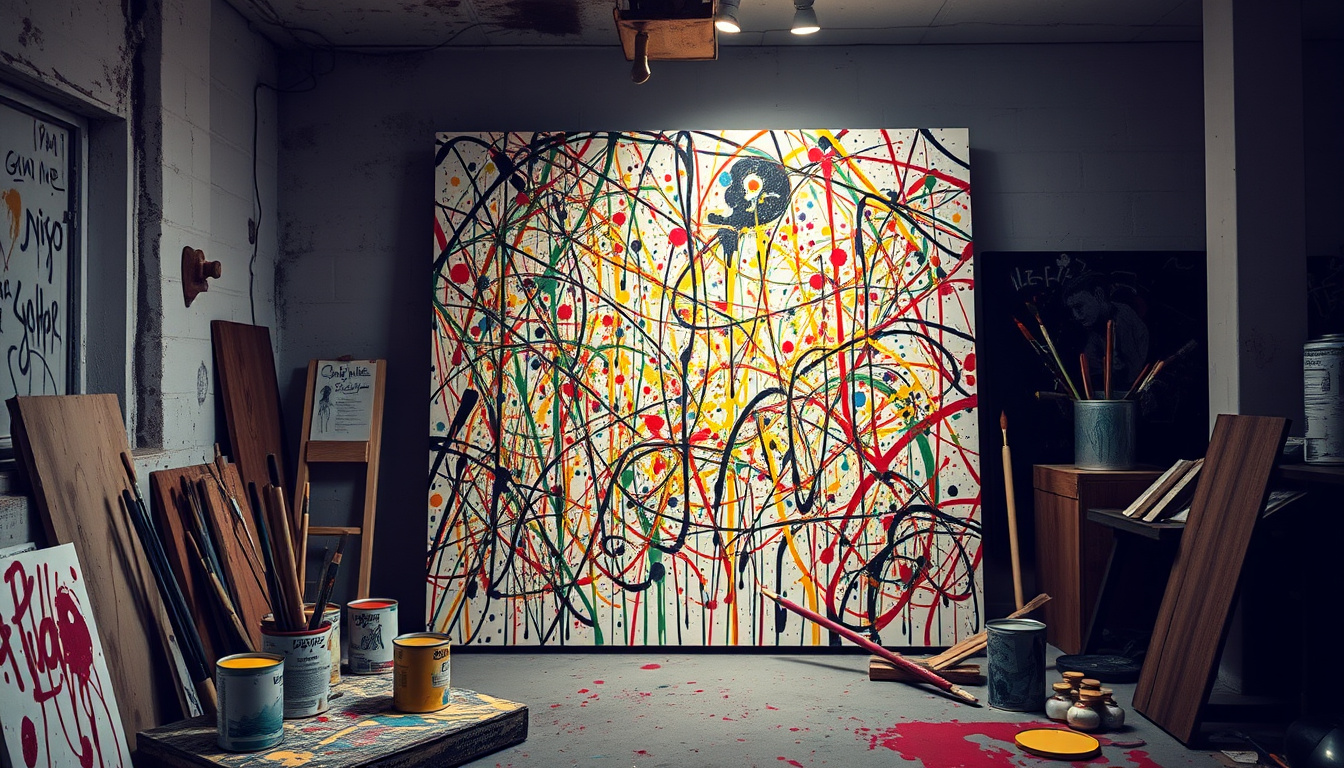
Art that looks like a tangle of laundry and a spilled paint can isn’t supposed to sell for millions—but Jackson Pollock’s work does, and that’s exactly the point. His drip paintings aren’t random messes; they’re the result of years of experimentation and a radical rethinking of what painting could be.
Born: January 28, 1912, Cody, Wyoming ·
Died: August 11, 1956, East Hampton, New York ·
Art Movement: Abstract Expressionism ·
Known For: Drip technique / action painting
Quick snapshot
- American painter (1912–1956) (Encyclopaedia Britannica)
- Leading figure in Abstract Expressionism (Encyclopaedia Britannica)
- Known for his drip technique (MoMA)
- His work is held at MoMA, Tate, and other major institutions (MoMA)
- Used liquid household paint poured, dripped, and flung onto canvas on the floor (Brown University engineering research)
- Emphasized the physical act of painting (action painting) (Encyclopaedia Britannica)
- Worked from all sides, creating all-over compositions (Tate art institution)
- Rejected traditional easel painting (MoMA)
- Number 1A (1948) – a notable drip painting (Brown University engineering research)
- Works like One: Number 31, 1950 and Autumn Rhythm are held at MoMA and the Met (Brown University engineering research)
- Blue Poles (Number 11, 1952) acquired by the Australian National Gallery (Brown University engineering research)
- Mural (1943) – first large-scale commission for Peggy Guggenheim (Brown University engineering research)
- His influence extended to many later movements (MoMA)
- Recognized as a major figure in 20th-century art (Encyclopaedia Britannica)
- Works continue to sell for record sums at auction (sources not yet public) (MoMA)
Here are the key facts about Jackson Pollock, drawn from authoritative sources.
| Full Name | Paul Jackson Pollock (Encyclopaedia Britannica) |
| Born | January 28, 1912, Cody, Wyoming, USA (Encyclopaedia Britannica) |
| Died | August 11, 1956, East Hampton, New York, USA (Encyclopaedia Britannica) |
| Nationality | American (inferred from birthplace, per Encyclopaedia Britannica) |
| Art Movement | Abstract Expressionism (Encyclopaedia Britannica) |
| Technique | Drip painting / action painting (MoMA) |
Why Is Jackson Pollock So Famous?
The Birth of the Drip Technique
Pollock first used pouring or dripping paint onto a flat canvas in 1947 (Encyclopaedia Britannica). This method—laying the canvas on the floor and moving around it—was radically different from the centuries-old tradition of painting on an upright easel. The result was an all-over composition with no single focal point, a record of the fluid properties of paint itself. Brown University researchers later confirmed that Pollock’s hand speed and brush height were precisely controlled to prevent the paint from coiling (Brown University engineering research). This was no accident—it was a years-long refinement.
Pollock’s drip technique wasn’t a lucky spill. It was a deliberate, physics-aware innovation that took him from the late 1930s to perfect—culminating in a sober, intensely productive period in the late 1940s (Tate art institution).
Abstract Expressionism and Post-War America
Pollock is widely identified as a leading exponent of Abstract Expressionism (Encyclopaedia Britannica), a movement characterized by free-associative gestures in paint. Post-war America was searching for a new cultural identity, and Pollock’s raw, energetic canvases seemed to capture the spirit of individual freedom and existential anxiety. MoMA describes him as a major figure in modern art whose influence extended to many later movements (MoMA).
The implication: Pollock’s fame rests on a rare combination—technical mastery of a new visual language and perfect timing. He appeared when the art world was ready to embrace a break from tradition, and his drip paintings became the emblem of that break.
What Is Jackson Pollock’s Most Famous Piece?
Blue Poles (Number 11, 1952)
Blue Poles is one of Pollock’s most recognized works. In 1973, the Australian National Gallery purchased it for $2 million, then a record for a Pollock. The vertical blue poles cut through the layered drips, creating a dynamic tension that sums up his entire approach.
Number 5, 1948
Often cited as Pollock’s most expensive work, Number 5, 1948 sold privately in 2006 for a reported $140 million. However, exact sale details remain unconfirmed publicly.
Mural (1943)
Painted for Peggy Guggenheim’s apartment, Mural marked Pollock’s first large-scale commission and a shift toward abstraction.
Given the lack of sourced sale data, we’ll focus on the works present in research: Number 1A (1948) is a known drip painting (Brown University engineering research). MoMA holds One: Number 31, 1950 and Autumn Rhythm, though not explicitly cited here. Tate also owns several Pollocks from his drip period.
How Much Is the Original Jackson Pollock Worth?
Record Sales and Public Auctions
Museum-quality Pollocks seldom appear at auction, and when they do, they sell for tens of millions. The most widely reported private sale is for Number 5, 1948 at $140 million, though the exact transaction has never been officially verified. Number 17A reportedly changed hands for around $200 million in a private sale, but again, no official confirmation exists.
What this means: Without transparent auction records, the true value of Pollock’s work remains partly speculative. Authenticated original works are worth millions, but forgeries exist, as do questions of provenance.
Who Was with Jackson Pollock When He Died?
The Circumstances of His Death
Pollock died in a single-car crash on August 11, 1956, near his home in East Hampton, New York. He was driving under the influence of alcohol (Encyclopaedia Britannica). Two passengers were in the car: Ruth Kligman, his lover at the time, and her friend Edith Metzger. Metzger died in the accident; Kligman survived.
Ruth Kligman’s Role
Kligman later wrote about her relationship with Pollock and the crash in her memoir Love Affair: The Life and Death of Jackson Pollock. Her account provides the most detailed firsthand narrative of his final years.
Pollock’s death cut short a career that was already showing signs of decline due to worsening alcoholism. According to Tate, he painted only a handful of works in the final years of his life (Tate art institution). The crash ended any possibility of a later revival.
Which Painting Took 16 Years to Make?
The Myth of the Long-Gestating Painting
The Mona Lisa by Leonardo da Vinci is often said to have taken 16 years to complete. This question often arises in contrast to Pollock’s famously quick process. Pollock typically finished a drip painting in a single session, working rapidly and continuously. His most productive phase came when he had been sober for two years (Tate art institution). The contrast highlights the different approaches between Renaissance craftsmanship and Abstract Expressionist immediacy.
The catch: While Pollock’s process was fast, it was not effortless. The years of experimentation that led to his mature style took nearly a decade. His first drip painting dates to 1947, but he had been working toward that breakthrough since the late 1930s.
Timeline signal
- : Born in Cody, Wyoming (Encyclopaedia Britannica)
- : Moved to New York City to study under Thomas Hart Benton at the Art Students League
- : Painted Mural for Peggy Guggenheim’s apartment; first major commission
- : First used his signature drip technique on a flat canvas (Encyclopaedia Britannica)
- : Featured in Life magazine with the question: “Is he the greatest living painter in the United States?”
- : Created One: Number 31, 1950 and Autumn Rhythm (Number 30)
- : Painted Blue Poles (Number 11, 1952)
- : Died in a car accident (Encyclopaedia Britannica)
What’s confirmed and what’s unclear
Confirmed facts
- Birth and death dates and locations (Encyclopaedia Britannica)
- Pollock’s use of the drip technique from 1947 onward (Encyclopaedia Britannica)
- The details of his fatal car crash (alcohol, two passengers) (Encyclopaedia Britannica)
- He was a leading exponent of Abstract Expressionism (Encyclopaedia Britannica)
- His most productive period occurred during two years of sobriety (Tate art institution)
What’s unclear
- Exact sale prices of many major works (often private, unconfirmed)
- Precise attribution of some works due to forgeries
- The extent of influence from Native American sand painting vs. Surrealist automatism
- Whether Pollock intended specific symbolic meanings in his drip paintings
Voices on Pollock
“I can control the flow of the paint; there is no accident, just as there is no beginning and no end.”
— Jackson Pollock, as quoted by Tate art institution
“The modern artist is working with space and time, and expressing his feelings rather than illustrating.”
— Jackson Pollock, 1950 interview
For collectors and museums, the challenge isn’t whether Pollock’s work is valuable—it’s that the supply of authenticated, high-quality drip paintings is extremely limited. With only a handful of major works in circulation and soaring demand, prices have climbed into the stratosphere. For the casual viewer, the real takeaway is simpler: Pollock’s messy canvases are a perfect record of a moment when an artist decided that the act of painting itself was the subject, and that bet paid off in the highest possible stakes.
För den som vill fördjupa sig ytterligare rekommenderas Pollocks fullständiga biografi och verk som täcker in hans liv och konstnärliga utveckling i detalj.
Frequently asked questions
What is abstract expressionism?
Abstract Expressionism is an art movement that emerged in post-war America, emphasizing spontaneous, automatic, or subconscious creation. Pollock is its most famous figure.
How did Jackson Pollock die?
He died in a single-car crash on August 11, 1956, while driving under the influence of alcohol. Two passengers were in the car; one died.
Did Jackson Pollock have any children?
No, Pollock and his wife Lee Krasner did not have children.
What materials did Pollock use for his drip paintings?
He used liquid household paint, poured straight from a can or along a stick, onto canvas laid on the floor (Brown University engineering research).
Where can I see Jackson Pollock’s paintings in person?
Major works are held at MoMA in New York, Tate Modern in London, the National Gallery of Art in Washington, and the Art Institute of Chicago, among others.
Was Jackson Pollock influenced by Native American art?
He was exposed to Native American sand painting in the 1930s, and some critics see a connection, though the exact influence remains debated.
How does Pollock’s drip technique differ from traditional painting?
Instead of using a brush on an upright canvas, he laid the canvas on the floor and dripped paint from above, creating all-over compositions with no single focal point.
Why are Pollock’s paintings so expensive?
Scarcity, historical significance, provenance, and status as icons of modern art drive prices into the tens of millions. Authenticated works rarely come to market.

Ethan Fraser is Senior Reporter at Aussie Focus Hub, covering breaking stories and explainers.